Deserts, tundra, savannah, grasslands, and chaparral are all biomes that do not have access to regular supplies of water. Therefore, all organisms need to have ways to survive the times when things are dry.
BlogWork
Watch the video and describe at least three ways the organisms in the video have adapted to survive draught.
Monday, March 17, 2014
Tuesday, March 11, 2014
Taiga!
This week, we have been discussing the Taiga biome, a coniferous forest that covers a huge swath of land just below the Arctic circle. Almost all of Canada and large portions of Russia and China are covered in this beautiful biome. Humans have done some damage to the ecosystem over the years, but there are also many groups trying to help protect and preserve the land. One controversial area of conservation is the reintroduction of wolves into Yellowstone Park.
BlogWork
Watch the video. PBS.org
)
Discuss the pros and cons of reintroducing wolves into Yellowstone National Park. Please write a paragraph.
Monday, January 27, 2014
Biomes!
This week we begin a new unit on Biomes. Biomes are areas on the earth characterized by specific types of plants and climates. We live in a temperate deciduous forest which means that the plants need to find ways to survive in all four seasons. How have the trees in this area adapted to survive these cold winter days?
BlogWork
Watch the following video and write down three to five sentences describing the Karoo Biome.
BlogWork
Watch the following video and write down three to five sentences describing the Karoo Biome.
Thursday, January 9, 2014
Adaptation!
Today, we spoke briefly about adaptation, which is the theme for the curriculum on the middle school team. Essentially every part of a living organism is some form of adaptation, but some adaptations are cooler than others. One of my personal favorite adaptations is bioluminescence, the ability of an organism to produce its own light (like fireflies). Check out this video: NY Times
BlogWork
Define "adaptation" and then give an example of one of your favorites. As always, please write a complete paragraph.
Monday, January 6, 2014
Classification!
Hello and welcome to BlogWork! This is our first BlogWork assignment for the year so let's start off strong. All posts should be written in your own words and in paragraph form. I highly recommend having them proofed first.
This week, we will be talking about the classification of life. Why do we classify things? What purpose does it serve us? Well, could you imagine if there were no classifying systems in the world? What would it be like to step into a grocery store? Yikes! You would never find anything! Thankfully, Carolus Linnaeus developed a system so that we can organize all of the life that exists in the world. This system, created in the 1700's, is still used today.
BlogWork
Go to the following website: Time.com
Read about one of the new species that was discovered in the past year and write a paragraph in your own words about the animal.
Post your paragraph in the comments section of this post.
This week, we will be talking about the classification of life. Why do we classify things? What purpose does it serve us? Well, could you imagine if there were no classifying systems in the world? What would it be like to step into a grocery store? Yikes! You would never find anything! Thankfully, Carolus Linnaeus developed a system so that we can organize all of the life that exists in the world. This system, created in the 1700's, is still used today.
BlogWork
Go to the following website: Time.com
Read about one of the new species that was discovered in the past year and write a paragraph in your own words about the animal.
Post your paragraph in the comments section of this post.
Tuesday, October 1, 2013
Thursday, March 7, 2013
WASTE!
This week in the middle school, we have been collecting all of our trash in order to gain a sense of what type of trash we produce and how much of it gets thrown away. Next week, we will take a closer look at garbage and what we do with it as a society.
For extra points, watch this one also and comment on it.
BlogWork!
Watch the video and write a response to what you see and hear. One paragraph, please.
For extra points, watch this one also and comment on it.
Monday, February 18, 2013
The Pitch Drop Experiment!

Classwork:
All students should work on creating their advertisement for their energy source.
Students should have at least one page of bulleted notes before they can work on their advertisement.
Students can use any of the modalities for creating a presentation used in the past (i.e. hand drawn, powerpoint, SlideRocket).
Advertisements need to have slogans, and are limited to one page.
BlogWork
Go to the following website: NationalGeographic.com
Pick one article from this page, read it, and write a one paragraph response to it.
Monday, February 11, 2013
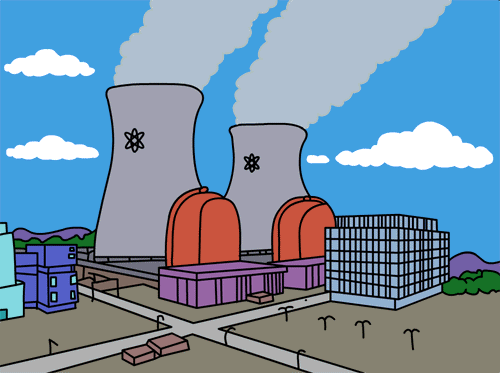
Nuclear Power!
This week we will discuss the first non-fossil fuel related energy source. Nuclear energy is a way for us to get electricity without burning coal. In some ways, nuclear power is an extremely clean way to get electricity because there is no carbon dioxide released into the atmosphere. However, nuclear power comes with significant risks and challenges. Many people believe that it is definitely not worth it.
BlogWork
Watch the video below. Write down 3-5 facts about nuclear power that you learned from the video. Then, write down a couple of sentences describing whether you think you support or oppose nuclear power. Give detail as to your reasons.
And/Or this one...
BlogWork
Watch the video below. Write down 3-5 facts about nuclear power that you learned from the video. Then, write down a couple of sentences describing whether you think you support or oppose nuclear power. Give detail as to your reasons.
And/Or this one...
Wednesday, January 23, 2013
POWER!
Greetings Middle Schoolers! Welcome to DC Science World!
For the last few weeks we have been talking about energy resources. Fossil fuels are the primary way that we get our power and power, in the form of electricity, is what drives a large portion of our lives (i.e. this assignment). But how does that rock of coal get turned into a game of Fun Run, Minecraft, or an episode of Adventure Time?
BlogWork
Go to the following website: www.nationalgeographic.com
Pick one article on this page about energy. Read it and write a detailed paragraph in response to the article. Describe what it was about and highlight the most important points.
For the last few weeks we have been talking about energy resources. Fossil fuels are the primary way that we get our power and power, in the form of electricity, is what drives a large portion of our lives (i.e. this assignment). But how does that rock of coal get turned into a game of Fun Run, Minecraft, or an episode of Adventure Time?
BlogWork
Go to the following website: www.nationalgeographic.com
Pick one article on this page about energy. Read it and write a detailed paragraph in response to the article. Describe what it was about and highlight the most important points.
Tuesday, April 24, 2012
Slime!
We are now studying Kingdom Protista, a large group of organisms ranging from single celled amoeba to giant kelp. The kingdom is vast and contains an extremely wide array of types of life. There are organisms that are animal-like, others that are plant-like, others that are similar to fungi, and even some that contain characteristics of all three. I find many of the organisms in Kingdom Protista fascinating, but my favorite is the slime mold.
BlogWork
Watch the video about the researchers and answer the following questions:
- How would you characterize or classify slime mold (and why)?
- Why might researching slime mold be a lucrative endeavor (why might it make someone a lot of money)?
- How do they conduct their research?
Bonus Video!
Tuesday, April 10, 2012
Nitrogen Fixation!

As we begin talking about the kingdoms of life on our planet, we will start by learning about the smallest forms of life, known as microbes. Microbes are tiny, tiny forms of life that are essential to the growth and development of all other aspects of life. While there is a tendency to be repulsed by the thought that our planet is actually ruled by these microscopic critters, it is actually important that we recognize the tremendous value they serve us.
BlogWork!
Watch the video below and write 5-10 sentences about the importance of the microbe world.
Tuesday, March 6, 2012
Invasive Species!
We have been studying the natural states of the world biomes and spent a little bit of time thinking about the threats to them. Mostly, threats involve human involvement, like when people chop down huge swaths of rain forest or set fires accidentally in dry conditions. Humans are paving large sections of natural ecosystems and preventing migratory patterns and disrupting access organisms need to food and water.
Another problem, which is also usually caused by human involvement, is the spreading of invasive species. An invasive species is a plant or animal that does not belong in an ecosystem and which ends up dominating. Sometimes this is done by accident, as when seeds get dispersed through shipping containers. Other times it is done purposefully, as when someone thinks that bringing in an animal in one area will help control a pest problem.
Check out this one:
or this one...
BlogWork
Go to the following website: Invasive.org
Search through the website and find 7-10 interesting facts about invasive species. Write the facts in your own words. [I recommend clicking on the tab called "Invasive 101"]
Tuesday, February 28, 2012
What's so funny!?!

Yesterday I assigned the class a challenging question to reflect upon. Why do we laugh? What purpose does humor serve us and why did we evolve to have it? I thought we had some great responses to that question, but also know that some people really struggled to think of the ways that it might benefit people. Is it possible that it serves absolutely no purpose? Perhaps it is what it is and we shouldn't over-analyze it. Possibly.
Here is an article written on the subject for those of you who are curious. Why Do We Laugh?
Read this and comment on it for extra credit.
Tuesday, February 21, 2012
Indicator Species!

Some animals can act as an early warning system to environmental scientists that there is a problem brewing in an ecosystem. For example, back in the 1800s, coal miners used to take caged canaries into the mines with them. The birds would sing and chirp often. However, if the bird stopped singing it was an early indication that there might be poisonous gases in the mine that would be harmful to the miners. This system would allow the miners to evacuate the mine before the poisonous gases killed the miners. Environmental scientists can look out for certain animals in an ecosystem which will give them an indication as to the health of that region. Birds and butterflies are excellent indicator species because they can be affected quickly by environmental changes.
BlogWork
Go to the following website: Marietta College: Biome Study
On the map, click on one of the biomes.
Read about the indicator species (plants and animals) of that region.
Write a few sentences about the indicator species of that region.
Thursday, February 16, 2012
Lungfish!
As we look at all of the different biomes and the amazing adaptations that animals have acquired in order to survive in the most challenging of environments, we need to pause every now and then and appreciate the slimiest of those organisms.
BlogWork
Watch the video about the Lungfish. Write a comment (1-2 sentences) about the video. Then describe a creature in the biome that you are studying that also has an amazing adaptation.
Monday, January 30, 2012
Rainforest!

As we pursue our understanding of biomes, we will work to break down the differences between them. The first one that we are studying, the rainforest, is quite possibly the most complex. One of the most complex ecosystems in the world, rainforests are also one of the most endangered. Humans are cutting down huge sections of this vibrant ecosystem at an alarming rate. Given that new species are being discovered all the time, it is disheartening to think about the plants and animals that will disappear without our even knowing about it.
BlogWork
Go to the following website: ScienceDaily
Pick an article to read about the rainforest.
Read the article and write a paragraph synopsis of the article.
Sunday, January 22, 2012
Biomes!

Biomes are large parts of our planet that are categorized by similar climactic conditions that lead to specific types of plants and animals. The climate drives the plants and the plants drive the animals. Living organisms adapted to survive in every of type of biome in the world. From the tundra, to the desert, to the rainforest, life finds amazing ways to thrive.
BlogWork
Go to the following site: National Geographic Habitats
Scroll down to "Habitats Topics."
Pick one of the habitats listed on the page and click on it.
Read the article.
Write down 5-10 adaptations referenced in the article.
Subscribe to:
Posts (Atom)